




Be the first to hear about our customer offers, events and webinars
How to spot common gaps and take a more structured approach to continuous improvement
Moving to Oracle Cloud Applications is a major step forward, but go-live is only the start of the journey. Your Software as a Service (SaaS) environment brings with it a whole new way of working, with value delivered over time. Monthly and quarterly updates, new features and continuous improvement are all part of the model. But it can be difficult to keep pace.
All too often, maintenance becomes minimal and reactive. Improvements stall. And the value of your investment starts to plateau.
Read on for the five most common warning signs that it may be time to take a closer look at how your SaaS environment is maintained.
1. Oracle software updates feel rushed or disruptive
Oracle’s quarterly Fusion updates are designed to deliver continuous innovation, but they can quickly become a pressure point. Add to that the introduction of monthly security patches and team capacity can quickly become strained.
With tight timelines for impact analysis, regression testing and deployment, teams can end up focusing on doing ‘just enough’ to stay current.
When updates feel disruptive rather than routine, it’s usually a sign that processes, tooling or resources aren’t fully aligned.
What does good look like?
A structured, repeatable approach to update management, where impacts are understood early, testing is trusted and reliable, and adoption is planned rather than rushed.
2. New features are identified, but rarely adopted
Each release introduces new functionality, but in many organizations those features are, at best, logged, reviewed… and then parked. Often without a clear decision whether to adopt or ignore them.
This is often a prioritization and governance challenge. Without a defined process to assess business value and align changes to a roadmap, improvements struggle to move forward, even when the intent is there.
What does good look like?
A clear process for capturing, assessing and prioritizing the enhancements that are aligned to your business roadmap, so that innovation becomes part of day-to-day operations.
3. Audit and compliance requests trigger last-minute scrambles
Audit readiness is often where the gaps in SaaS maintenance become most visible.
If it’s difficult to evidence configuration changes, testing outcomes or update activities, preparing for audits can become stressful and time-consuming.
The same applies to subscription usage and role configurations, particularly in more complex environments. If these aren’t well documented and up to date, they present compliance risks and, perhaps worse, significant financial penalties to the business.
What does good look like?
Clear consistent documentation and reporting, so that compliance is built into everyday operations. The use of specialist automated tooling such as Rapid4Cloud™ is an effective way of managing these risks.
4. Non-Production environments aren’t trusted
Effective testing depends on having confidence in your Non-Production environments.
When non-production environments drift out of sync with Production, testing becomes unpredictable and you can’t rely on the validity of your results. This slows everything down and introduces the risk of issues making their way into Production.
What does good look like?
Production and Non-Production environments are aligned and well-managed with clear schedules and processes to ensure that testing is consistent, reliable and efficient.
5. Operational demands crowd out improvement
Day-to-day operational work like managing updates, maintaining environments and responding to issues can quickly consume team capacity.
As demands grow, there is limited time to step back, assess opportunities, or progress change. The focus naturally shifts to maintaining stability, with little capacity left to move improvements forward.
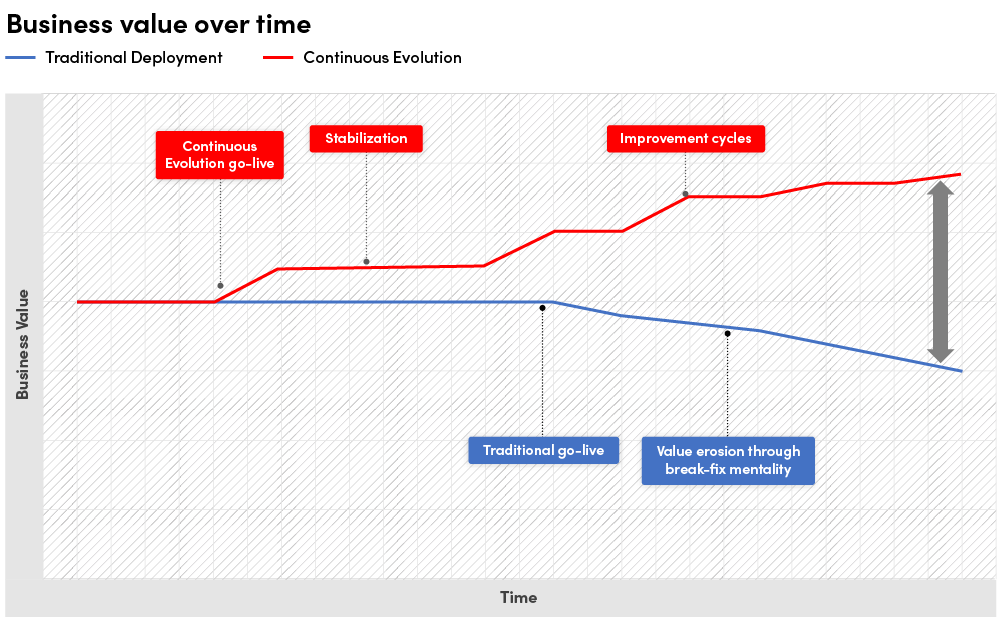
In a SaaS model, this distinction matters. Maintenance keeps the system running, but improvement is what drives ongoing business value. Without capacity for that work, progress slows.
The illustration below shows how an evolutionary approach can help maximize value from your Oracle investment.
What does good look like?
A balanced operating model, where routine maintenance is efficient and predictable, and ownership is in place to prioritize and deliver improvements that support the business.
A practical way to stay ahead
Improving how your Oracle SaaS environment is maintained doesn’t necessarily require a full overhaul, but it does require better visibility and structure.
One underused capability worth considering is the Oracle AI Success Navigator.
Included with Oracle Cloud Applications, it helps:
- Understand which features are in use, and which aren’t
- Explore new functionality through AI-powered access to release content and documentation
- Build a forward-looking roadmap based on identified gaps
- Track progress against improvement initiatives over time
Used effectively, it can provide a more structured view of where you are today, and where you could go next.
By coupling AI Success Navigator with a specialist automation tool like Rapid4Cloud™, for example, organizations can be confident that their ongoing SaaS maintenance activities are under control, leaving them to focus on driving true business value.
Next steps
If these warning signs resonate, you aren’t alone. Many organizations reach this point as their SaaS environments mature. The key is recognizing when it’s time to move from a reactive ‘keeping the lights on’ approach to a more structured model focused on continuous improvement.
Do these warning sounds feel familiar?
Many organizations reach a point where maintaining Oracle Cloud Applications becomes increasingly complex and time-consuming.
See how Oracle SaaS Maintain simplifies updates, testing, compliance, and environment management.